GTA 6 · mini-game · walkthrough
Tenebrae Lux: the GTA 6 puzzle, explained and playable
Six dates, ten room details and a phone that only wants six digits. Below is a browser rebuild you can play without a console — walk the bunker, find what changed in the room, then cross the ruins.
Playable rebuild · stage 1 of 2
The bunker: find the one thing that changed
Ten things in the room. One of them is not the way it usually is. Tap it. Then walk to the next date. Six dates, one changed thing each — those six things spell a code.
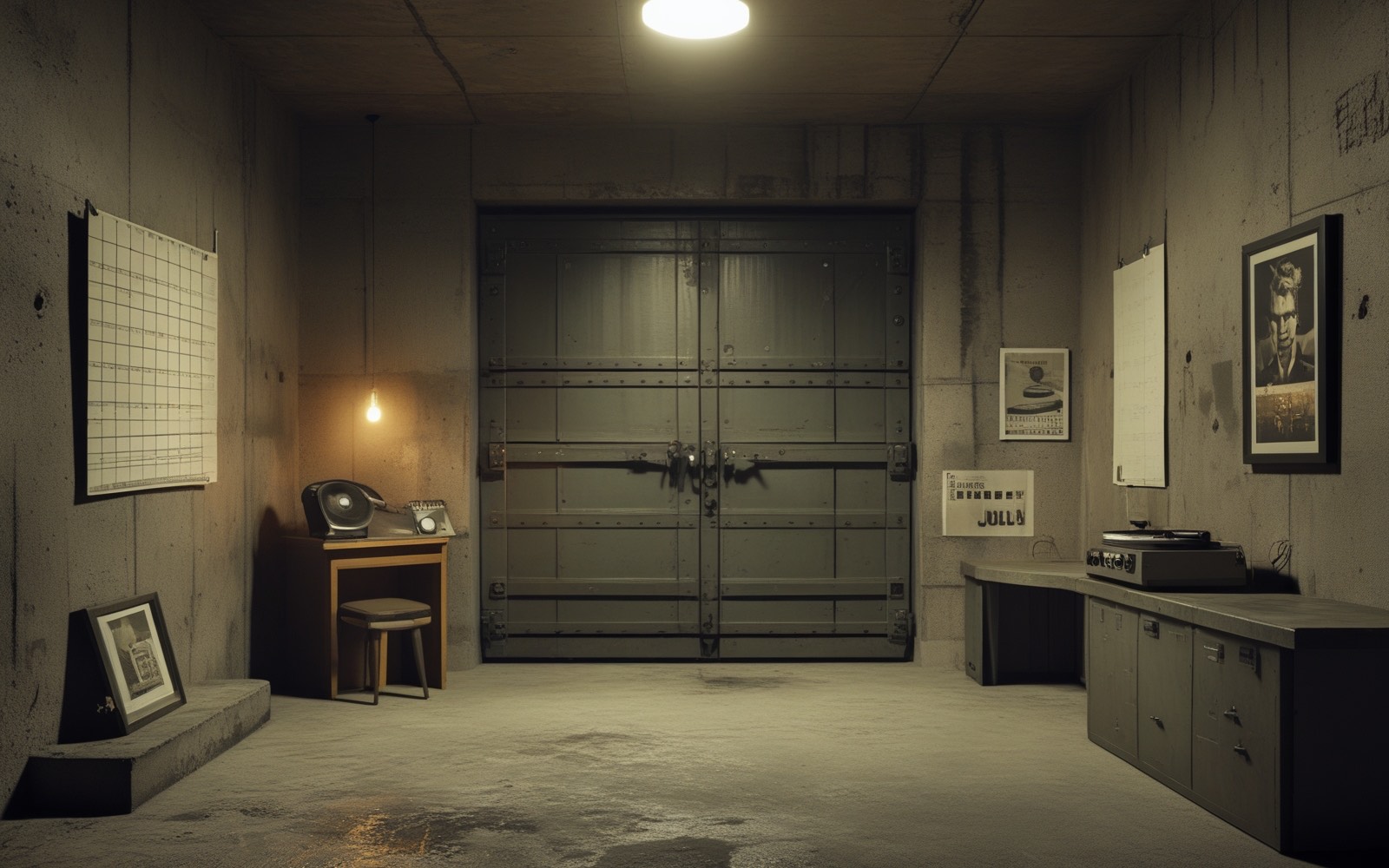
The room when nothing is wrong
Press Enter the room to climb the stairs.
Conversion sheet — what each reading means
Observation sheet
Door open
Six digits, in date order
- Time
- —
- Submissions
- —
- Code
- —
Assisted run — you revealed the answer before dialling.
Playable rebuild · stage 2 of 2
The ruins: cross by stepping on the right stones
The poem names seven objects in an order. Each object stands somewhere in the ruins, and the arch beside it carries a symbol. Step on the stones in that order. One wrong stone and the ruins rearrange.
Skip the line about The Eternal March. The last line names two objects.
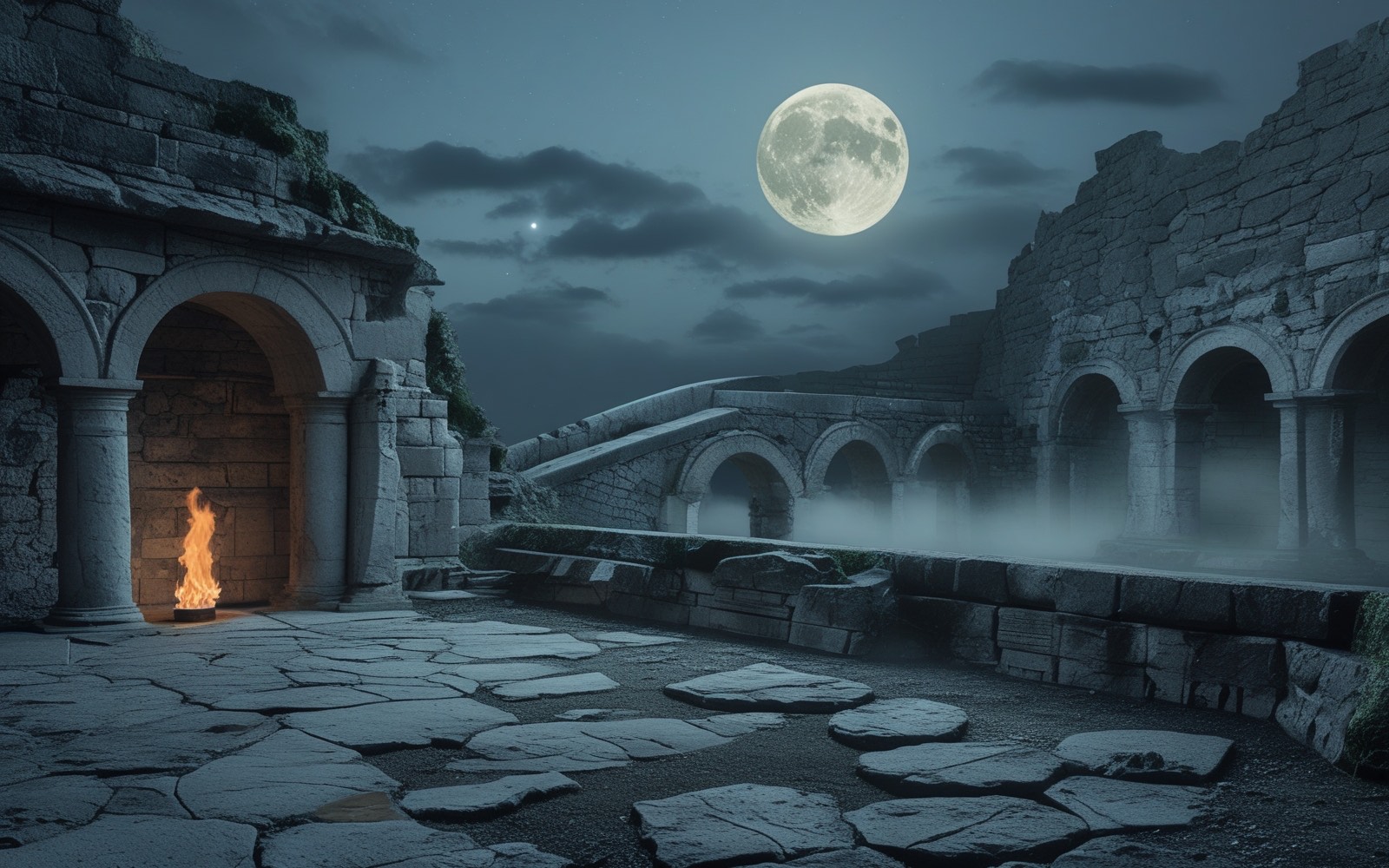
Press Read the poem to start.
Tenebrae Lux is a game inside GTA 6, not a separate release. You boot it on the JoySystem console in Jason's house, clear the first four boards, and then it stops being that kind of game: you drop into a bunker with a room that will not open the way the earlier boards did. From there it becomes a notebook puzzle — one changed detail per visit, six digits on a keypad, and then a second, harder puzzle about a poem, seven objects and a bridge.
This page explains both halves, and both halves are playable above: the bunker keypad with a fresh randomised room every time, and the ruins-and-bridge walk with a fresh layout every time. Tenebrae Lux is a first-person console mini-game and cannot be embedded as-is; these are rebuilds of its two puzzles in plain HTML, with no Rockstar assets.
Why no single code works for everybody
The six digits are not fixed. Each of the six dates shows one anomaly, and both the anomalies and the values are randomised per playthrough, so codes posted in threads (players have shared 341376, 416643 and others) only fit the run they came from. Everything you need is inside the room.
The phone puzzle: six dates, one anomaly each
Every time you climb the stairs you arrive on one of six dates: 11 October, 14 October, 20 October, 23 October, 27 October, 30 October. The calendar to the left of the phone tells you which one you are standing in. Each date hides exactly one anomaly — one element that is not behaving the way it normally does — and each anomaly stands for one digit.
- Make a sheet: the six dates across the top, the ten possible anomalies down the side.
- On each visit, write down what every element is doing, normal or not. The normal readings are your control.
- Compare the six visits. The element that changes on one date only is that date's anomaly.
- Put the six readings in chronological order, turn each into a digit, dial the six digits and press #.
The ten possible anomalies
| Element | What changes when it is the anomaly |
|---|---|
| Painting by the door | The columns in the painting change shape into Roman numerals |
| Lamp by the calendar | It flashes a sequence of lights — Morse code |
| Record sleeve | A price sticker appears on the sleeve where there was none |
| Turntable | The platter speed changes, or stops |
| Phone on the desk | It logs a different number of calls, or one that left no ring |
| Protocol number | The line at the top of the desk document is legible instead of redacted |
| Clock above the calendar | It shows an unusual time, or both hands straight up instead of a normal hour |
| Zuchworks Engine splash | The symbol at the end of the "Developed Using Zuchworks Engine" line changes (a Greek numeral) |
| Framed photo | It has fallen open, showing a number of people — or an empty room |
| Tape player | The recording mentions a different date, or counts down to zero |
Not every element exists in every room of the retail game. You may have no clock, no framed photo, a tape player you cannot use, or a phone you cannot hear ring. That is not a missing clue — those anomalies are simply not part of your run, and the six you do get are still six different ones. The browser rebuild above always shows all ten readings so the comparison is visible on one screen.
From a reading to a digit
| Reading in the room | The digit it gives |
|---|---|
| Roman numeral on the painting | nulla=0, I=1, II=2, III=3, IV=4, V=5, VI=6, VII=7, VIII=8, IX=9 |
| Lamp flashing Morse | the Morse digit: ----- = 0, ·---- = 1 through ····· = 5, -···· = 6 through ----· = 9 |
| Record price tag | the dollar figure before the decimal ($6.99 gives 6, $0.99 gives 0) |
| Turntable speed | the tens digit of the rpm reading; a still platter is 0 |
| Call counter under the phone | how many calls it logged; 0 means a call that left no ring |
| Protocol number | the digit right after the leading 0 (07-217 gives 7, 00-217 gives 0) |
| Clock | the hour it shows; both hands straight up is 0 |
| Greek numeral on the engine splash | ∅=0, α=1, β=2, γ=3, δ=4, ε=5, ϛ=6, ζ=7, η=8, θ=9 |
| People in the fallen photo | how many people are in the picture; an empty room is 0 |
| Date spoken on the tape | the day number ("the 7th" gives 7); a countdown that stops at zero gives 0 |
Every digit in the code can be 0, so a reading that converts to zero is a normal answer, not a failed reading. The repair note in the room is the one that tells you which element is wrong; the table is what turns its new reading into a number.
Read this table as the rebuild's rules, not the retail game's. The retail puzzle hands you its own conversion sheet and the exact sheet can differ from run to run, so do not carry these numbers into the console version. What is documented from the guides is the shape of the puzzle — six dates, one changed detail per visit, a digit per date, then the ruins and the bridge. The specific readings above are the rebuild's own, and the game prints them back with the readings so the arithmetic is always checkable.
The ruins and the bridge
After the phone, a second puzzle waits outside: a poem, seven objects standing in the ruins, seven carved symbols, and a bridge you can only cross by stepping on the symbols in one order. Step wrong and you are sent back to the start, and the objects move, so the layout has to be read again before the next attempt.
The seven objects are a moon sculpture, a sundial, a pot with soil, a trophy, a tree, a brazier and a fountain. Where they stand, in the order players usually read them:
| Object | Where it is |
|---|---|
| just past the poem sign | first object you meet |
| straight ahead | as you enter the ruins |
| right-hand room | off the entrance |
| left-hand room | off the entrance |
| second object in the left room | after the first one in that room |
| back-right corner of the two-object room | look right of the rocks |
| past the two-object room | on the way to the bridge |
Each of those seven positions has a symbol carved nearby, and that symbol is the one you step on later:
| Where the symbol is | Which object it stands for |
|---|---|
| Above the arch at the entrance, past the poem | the object straight ahead when you enter |
| Turn around and look above the arch you just came through | the object just past the poem |
| Above the arch into the right-hand room | the object in the right-hand room |
| Above the arch into the left-hand room | the object ahead in that room |
| On the rocks in the back-right corner of the left room | the object beyond the rocks |
| Above the arch in the left room that leads to the bridge | the object on the path to the bridge |
| Pass the bridge arch, then turn around and look up | the second object in the left room |
Then read the poem. Skip the line that reads "The Eternal March", and write down every object it names in the order it appears — one line can name more than one object, and every reference counts. Lines about sleep and rest move their object in the sequence, which is exactly why a written list beats trying to hold it in your head. Then cross: step on the symbols in the order you wrote down.
How the rebuild above works
Press Enter the room and the room appears on the first of the six dates. Every one of the ten elements is listed the same way: what it reads right now, and underneath it, in grey, what it reads normally.
The anomaly is the row where those two lines disagree. One element per date has changed, so one row stops matching its own baseline — a clock that normally stops at 12:00 now reads 5:00, a record sleeve that is normally blank now carries a price tag. Comparing ten short lines is the whole task; you do not have to remember the other five dates, because each room states its own baseline. Tap that row.
Marking the wrong row is not fatal, but it is not free progress either: the observation sheet says not what changed next to it, and the digit you would get from a normal reading is the wrong digit.
That is the whole reading loop. Six dates, one row each. The ← Prev date and Next date → buttons move between dates as often as you like, and tapping a different row on a date you already visited replaces that mark. Nothing is judged until you press #, so re-reading costs nothing.
When all six dates are marked, the conversion sheet under the game turns each reading into a digit — it lists all ten readings for all ten anomalies, including the ones that mean 0. Type the six digits in date order and press #. A wrong code is rejected without penalty and the room does not change, so you can re-check one date at a time. On success the panel shows your time, how many submissions it took, the six rows of working, and the code itself. New room builds a different playthrough. If you get stuck, "Stuck? Reveal the solution" fills in the six answers and marks the run as assisted — the result panel says so, so a helped win is never shown as a clean one.
Stage 2: walking the bridge
The ruins rebuild further up this page is the second puzzle, and it is a matching problem rather than a reading problem. Each of the seven objects stands at one of seven places, and one symbol is carved above the arch at each place — the game gives you "where each object stands" and "what is carved where" as two separate lists for exactly this reason. The poem gives you the order of the objects; the stones on the bridge carry only symbols, with no place name on them, so the work is object → place → symbol, seven times.
A wrong stone sends you back to the start and re-randomises every place and every symbol, so a guessed sequence cannot be retried by memory — you have to read the layout again. The game also stops telling you which object comes next after each correct stone; the poem is the only source of that order. The line beginning "The Eternal March" is the one the poem tells you to skip, and the last line names two objects, which is where most attempts lose a step.
FAQ
Is Tenebrae Lux a whole game inside GTA 6?
It is a mini-game, played on the JoySystem console in Jason's house. It has two puzzle strands back to back — the boards first, then the bunker room with the phone, then the ruins and the bridge outside.
Why does my phone code not match the code in a guide?
Because the anomalies and their values are randomised per playthrough. A posted code belongs to one player's six dates. Read your own room.
Can a digit in the code be 0?
Yes. Every one of the ten anomalies has a reading that converts to 0 — a still platter, an empty photo, a countdown that stops at zero, nulla on the painting — so the placeholder 000000 on the keypad is a real possible code, not a hint that zero never appears.
What happens if I fail the bridge?
You are sent back and the seven objects move to new positions, so the symbol-to-object mapping has to be checked again before you try the poem order a second time.
Can I skip a date in the bunker?
Not while reading — you can move between the six dates freely and come back to one you skipped. What you cannot skip is marking all six before the keypad will judge anything: the game now refuses a submission until six dates are marked, because an unmarked date is a digit you have not read.
Is this page the real game?
No. This is an unofficial fan-made rebuild of the puzzle logic in plain HTML, with no GTA 6 assets or code. GTA 6 and Tenebrae Lux belong to Rockstar Games. The anomaly list and the ruin/bridge layout are documented from Game Rant's guides of 18–19 November 2026, and the deck readings used here are our own reconstruction.
Player notes
Did the room make sense?
Stuck on a date, think a reading is unfair, or solved it and want to say so? Say it here. Everything below is written by players, not by us — we only remove spam.
No notes yet. If a date confused you or a reading felt unfair, that is exactly the note worth leaving.
Player notes: 0